
Private Copying Global Study 2026
The Private Copying Global Study 2026 prepared by CISAC, BIEM, IFRRO and Stichting de Thuiskopie, offers the most comprehensive analysis to date of private copying and reprography remuneration systems across 196 countries. It provides practical insights into how private copying and reprography systems are developed, implemented and managed worldwide, including tariff-setting practices, legislative provisions, and key policy developments.

At a Glance
Private copying is a copyright exception that allows individuals to make personal, non-commercial copies of protected works. In return, creators receive “fair compensation”. This compensation is applied to certain media and devices capable of making copies such as smartphones and computers. The amount is based on market research on consumer copying behaviour.
Private copying systems have existed since the 1960s and continue to provide creators with a meaningful source of income.
Private copying systems are expanding rapidly, with strong momentum in Africa
Clear legal frameworks and industry cooperation are critical for success
Private copying remuneration generates over €1 billion annually for creators worldwide
Costs to consumers remain very low (around €1–€3 per year)
Governments must maintain technologically neutral and future-proof private copying systems
Private copying systems support creators and fund cultural and social programmes that benefit society
Key Messages
Private copying and reprography systems cover a broad range of copying activity across different types of creative works, including music, audiovisual, text, and images.
They benefit many types of rightsholders: musicians, book authors, performers, publishers, journalists, photographers, and visual artists.
They often provide these creators with an important supplementary source of income. In some countries in Africa, they serve as a primary source of income that help sustain creative professions.
Collected remuneration is distributed across multiple rightsholder groups, ensuring that the value generated supports the full creative ecosystem.
Africa is becoming a major growth area for private copying systems.
Regional initiatives such as the UEMOA Directive on the harmonisation of private copying remuneration and the ARIPO regional strategy, are encouraging countries to introduce or strengthen levy systems.
These efforts help establish sustainable income streams for creators and modernise copyright frameworks across the continent.
CISAC and IFRRO work with regional bodies and governments to develop clear legislative frameworks, provide technical guidance, and strengthen implementations.
2026 | 2020 | 2017 | |
Africa | 13 | 9 | 4 |
Americas | 4 | 4 | 4 |
Asia | 3 | 2 | 3 |
Europe | 31 | 29 | 27 |
Oceania | 0 | 0 | 0 |
The Study identifies three key success factors:
- Clear legal frameworks
- Transparent collection systems
- Strong institutional and industry cooperation
Private copying generally collects remuneration from manufacturers and importers of devices capable of copying works.
CMOs then distribute this income to creators without monitoring individual users.
CMOs play a central role acting as key intermediaries between rightsholders, industry and public authorities.
CMOs collect remuneration, manage funds and ensure efficient and transparent distribution to authors, performers, producers and publishers.
When designed transparently and proportionately, legal frameworks provide predictable and workable mechanisms for device manufacturers and importers, while ensuring fair compensation for creators.
Consumers increasingly store and reproduce copyrighted works in new ways.
Legal frameworks are evolving to reflect this.
For example:
- some jurisdictions have expanded their systems to include refurbished devices.
- some are implementing mechanisms to address cloud-based copying and services such as network personal video recorders (NPVR), which allow users to store or reproduce content remotely.
These developments illustrate the ongoing effort to maintain technologically neutral and future-proof private copying systems.
The goal is clear: creators must continue to receive fair remuneration as copying practices increasingly shift from physical media to digital and cloud-based environments.
From concerts to pensions, these funds help finance cultural projects, professional training, social support schemes for creators, emerging talent and cultural diversity.
By reinvesting revenues into culture, private copying remuneration strengthens both creators’ livelihoods and the broader cultural ecosystem.

“Private copying remuneration remains one of the most practical and balanced ways to ensure creators are compensated when their works are copied for personal use. As technologies evolve, legal frameworks must evolve too. This study highlights both the continued value of private copying remuneration and the opportunity for countries to update their frameworks to reflect the digital environment.”

“It is vital to draw on international experience and offer insights into the strengths and challenges of implementing effective private copying systems for the benefit of creators, particularly when the impact on consumers appears minimal.”

“This Study demonstrates the important role that private copying and reprography remuneration systems play in supporting a broad creative ecosystem, including the text and image sector. These systems ensure that authors, visual creators, journalists, and publishers, from books and academic journals to newspapers and magazines, receive fair compensation when their works are reproduced for private and personal uses. IFRRO welcomes this more inclusive picture of how private copying remuneration supports a diverse community of authors and rightsholders across the global text and image sector.”

“Without fair compensation, creativity fades. Private copying systems safeguard the livelihood of creators, while respecting the privacy of consumers when they copy protected works on their devices.”

"Africa is making meaningful progress in strengthening private copying remuneration frameworks, reflecting a growing commitment to fairly compensating creators. We are seeing real advances through national reforms and regional efforts, which are helping to build more coherent and effective systems across the continent. However, sustaining this progress will require stronger implementation, greater transparency and adaptation to evolving digital uses, so that these developments translate into real and lasting benefits for creators."
Key Economic figures
Private copying delivers a stable and significant revenue stream for creators, generating over €1 billion annually across surveyed countries.
At the same time, the cost for consumers remains low:
- €3.19 per person per year (tech-heavy households)
- €1.14 per person per year (lower device usage)
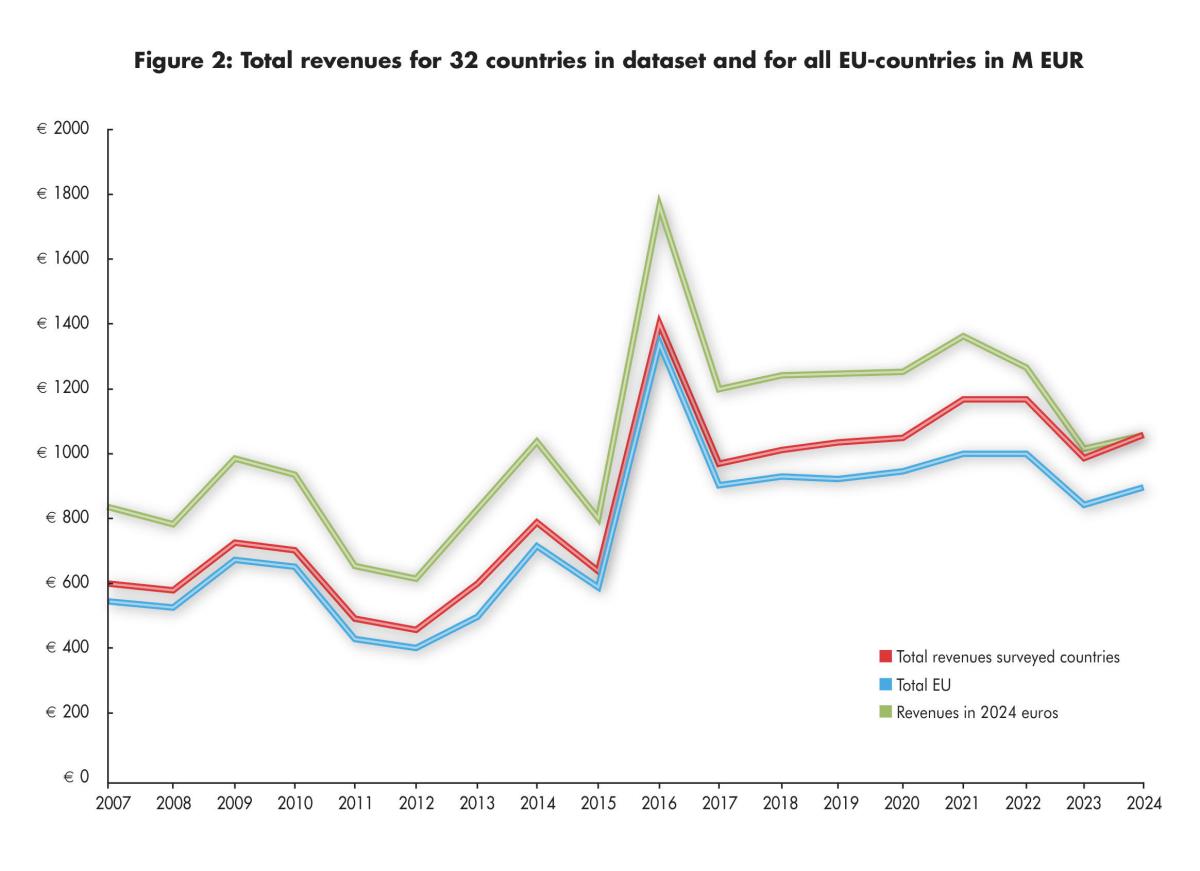
Across 32 countries, private copying levies have remained relatively stable over the years, despite inflation.
In real terms, they are close to between 2007–2010 levels.
While total revenues have remained stable since 2017 in current euros, they have declined in real terms (adjusted for inflation).
In many countries, private copying systems are not implemented or underdeveloped.
This limits creators’ access to a stable and reliable source of income.
In countries such as Bulgaria, Japan, Mexico, Nigeria and Poland, effective private copying systems could generate significant benefits for creators, with little impact on consumers.
Estimates based on IDC data show the potential value of applying levies to popular consumer devices (smartphones, computers, and tablets).
These predictive figures are provided to help policymakers:
- understand the importance of this revenue stream for creators
- consider the minimal per capita impacts of introducing such a system
Table 4: Benchmark levies and revenue potential for selected countries and devices
Benchmark levy based on media values (EUR) | Revenue potential based on benchmark levy and sales (M EUR) | ||||||||
Country | Smartphone | Computer | Tablet | Smartphone | Computer | Tablet | Total | Population (M) | Per capita (EUR) |
Bulgaria | 2.76 | 3.13 | 2.76 | 3.9 | 0.9 | 0.4 | 5.1 | 6.4 | 0.80 |
Japan | 4.28 | 4.86 | 4.28 | 129.3 | 66.1 | 25.1 | 212.7 | 124 | 1.78 |
Mexico | 3.84 | 4.36 | 3.84 | 114.9 | 19.1 | 7.4 | 139.2 | 131 | 1.08 |
Nigeria | 1.15 | 1.30 | 1.15 | 12.0 | 0.4 | 0.3 | 12.7 | 233 | 0.05 |
Poland | 3.33 | 3.78 | 3.33 | 29.3 | 0.8 | 3.2 | 40.3 | 36.6 | 1.13 |