Full text of the opening speech by CISAC Director General Gadi Oron at the CISAC General Assembly 2026
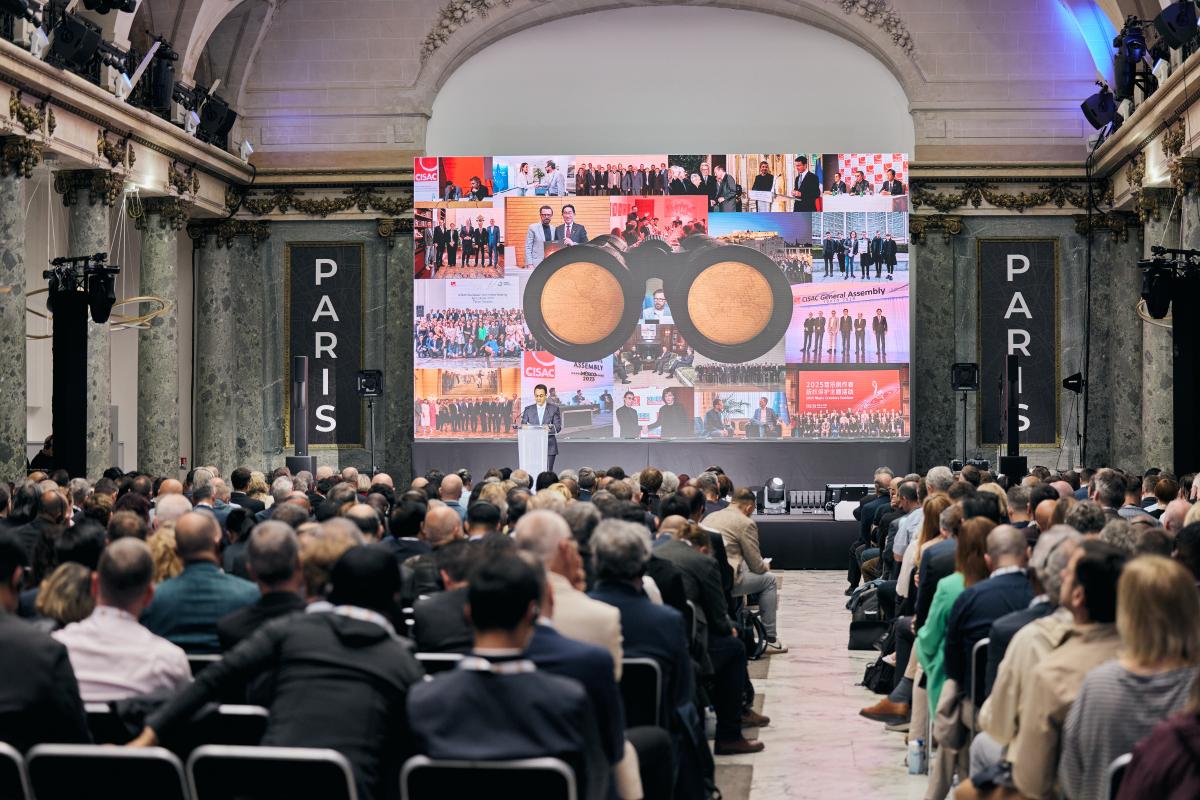
At CISAC's Centenary General Assembly in Paris, Director General Gadi Oron addressed delegates from around the world. The full text of his speech is reproduced below.
_______
Ladies and gentlemen,
Distinguished guests,
Dear colleagues and friends,
It is a pleasure and an honour to be here today with all of you, to celebrate a remarkable milestone – the 100th anniversary of CISAC.
And we are here in Paris - the city where, on the 13th June 1926, it all began.
Introduction
I would like to open with a story.
A story which was told at CISAC’s first congress, in 1926.
It was told by the French playwright and one of the four co-founders of CISAC, Robert de Flers.
A few years before the creation of CISAC, De Flers was walking to the theatre here in Paris.
As he was walking down the street, he came across a thin and visibly distressed woman. She was holding her child.
When he asked what he might do to help her, she replied: “Nothing.”
“But the child appears to be in pain,” de Flers said.
“Yes” she replied. “We’re both hungry.”
De Flers insisted on helping.
And the woman answered:
“I am living in poverty. And yet I am descended from Jean Racine.”
Jean Racine, of course, was one of the great playwrights of 17th-century France, along with Molière and Corneille.
This story was told not only at the first meeting of CISAC.
It was also told in 1976, exactly 50 years ago, here in Paris, when CISAC celebrated its 50th anniversary.
It may seem over-sentimental. But it reminds us of the economic struggles that creators – and their families - have always faced.
It says everything about why we are here.
It reminds us of the importance of protecting creators – and the crucial role of collective management in doing that.
And it sets the scene for what drove the launch of the first international organisation to protect creators’ rights – exactly 100 years ago.
Over the last century, the world around us has changed in ways the CISAC founders could not have imagined.
Creators have had to find new ways to create, express themselves, and reach audiences.
Societies have had to adapt to meet ever-changing market conditions and new technologies.
But there have been two key elements that have always remained the same:
The first, is that all these market changes and technological advances have been outweighed by a strong sense of continuity in the role of collective management.
And the second is the fact that, the challenges creators face today, are strikingly similar to those faced by our founders back in 1926.
Our history
Today, just as it was on the day CISAC was created, the fight for fair remuneration pitches creators against some of the world’s most powerful commercial entities.
Entities that make profits from creative works, but resist paying for them.
You will all be familiar with the famous incident that took place not far from here, where the French composer Ernest Bourget demanded that the Café des Ambassadors pay for performing his music.
When the café owners refused, the matter went to court.
Bourget won.
And that victory led to the establishment of SACEM, the first music collective management organization in the world.
This café was only a short walk away from here.
Another place that’s close is the Hotel Salomon de Rothschild, where the leaders 18 societies - gathered to discuss cooperation between them, and ended up establishing CISAC.
That meeting in June 1926 was organised by the leaders of SACD, the first authors society in the world, which was created by Beaumarchais - also here in Paris - in 1777.
The conviction that united the 18 societies who launched CISAC, was that creativity knows no borders, and that creators deserve protection everywhere.
And so, they decided to create a new entity – a Confederation – where they would be able to coordinate their activities.
And the rest – as they say - is history.
Growth and expansion
From those humble beginnings and early roots, CISAC has grown exponentially.
It expanded from its Eurocentric foundations to North America.
It continued to Latin America where CISAC’s first convention outside the Northern Hemisphere was held in Buenos Aires in 1948.
That convention was opened with a visionary speech by none other than Juan Perón, the charismatic President of Argentina.
CISAC later expanded to Africa and to Asia.
And what began with a handful of societies has evolved into a truly global network of more than 220 author-societies, across well over 100 countries.
The expansion was not only geographic.
CISAC has expanded from dramatic arts and music, into audiovisual works, literature and visual arts.
It has moved from simple coordination to establishing global standards and best practices.
It expanded to deal with technology tools, data and identifiers.
And it has become a global lobbying powerhouse, with influence at international, regional and national levels.
Our history teaches us an important lesson: that the challenges creators face today are not new.
These are the same challenges that our predecessors faced at the birth of each new technology.
Lessons and parallels
At that first convention in 1926, CISAC co-founder Robert de Flers spoke about the “intermediaries” who were attempting to control content, dictate terms and deprive revenue owed to creators.
He was referring - back then - to theatre owners.
In a modern setting, he could have been talking about streaming platforms, social media, auction houses or AI companies.
A year later, in 1927, the film The Jazz Singer was released.
It was the first motion picture that synchronised the human voice to the movement of the actors’ and singers’ lips.
The film studios quickly argued that the composers are not entitled to any royalties because the film was a new original work.
They claimed that once music was incorporated into a film, it lost its independent rights.
Nearly a century after The Jazz Singer, we are hearing this argument again – but this time it is from AI companies.
They claim that no royalties are owed for using creative works, because what they are doing is “transformative”.
Just like the film companies of the late 1920s, the AI companies argue that they have created something new.
They want to use creative works.
But they do not want to pay for them.
They want to generate profits from human creations.
But they want to keep all these profits for themselves.
History shows us that this has happened time and time again.
And history also teaches us that persistence – and strong collective action on our side – will always prevail.
Achievements to celebrate
When we look back and as we mark our centenary, there is much to celebrate.
First, our global network.
The very existence of a truly global network that connects societies across geographies and repertoires.
The second is the professionalization of collective management.
We have professionalized this sector through common governance rules, standards, and technology tools.
The third reason to celebrate is the impact of our advocacy work.
CISAC has engaged governments, multilateral institutions and decision-making bodies in almost every corner of the world.
This advocacy began all the way back to the second day of CISAC’s existence when our founders met in the Élysée Palace with Aristide Briand, the President of France at the time.
In the 100 years that followed, we continued in the same spirit.
We have constantly met with Presidents, Prime Ministers and many other politicians and decision-makers.
And we have put creators - our most prized asset - at the forefront of our lobbying efforts.
It has also enabled our message to have a real impact.
But beyond all of these achievements lies a deeper mission.
For a century, CISAC has reminded the world that culture is not a luxury.
It is a foundation of our societies. It is at the heart of our identity.
And behind every song, every film, every painting and every book, there is a creator whose livelihood matters.
But a centenary is not just a look back — it is also a mirror and a compass.
Looking ahead to the next century
So what might the next 100 years look like?
I can see a number of key tasks ahead, and important roles for our community.
We will need to continue to bridge the gap between usage and remuneration.
As modes of creation and consumption continue to evolve, the core problem of obtaining fair reward for creativity will remain.
I have no doubt that one of the key roles of CISAC will be to push for regulatory environments that uphold authors’ rights, rather than erode them.
We will need to advance the quality of metadata, data exchanges and transparency.
The next century will see accelerated digital developments and possibly new forms of interactive and immersive creation using AI.
For rights to apply and royalties to flow, the quality of data on rights and usage will have to evolve.
CISAC — with its global reach — is uniquely placed to foster new standards for works identification, and data exchanges that cross borders and media.
We will also need to support creators in emerging markets and repertoires.
Many parts of the world remain under-represented in the global rights ecosystem.
And some repertoires – like visual arts and audiovisual – are still lacking substantive rights in many countries.
We will need to continue to strengthen domestic laws and build collective management capacities to ensure that all creators are included in our global fabric.
We will also need to continue championing cultural diversity and the creator’s voice.
We have always been the guardian of plurality. But in an era of global platforms, local flavours and unique voices risk being sidelined.
One of our key roles will be to advocate for the value of cultural diversity, and to ensure that creators from all backgrounds and from every corner of the world benefit from effective protection.
And finally, we will need to adapt to new forms of creation.
The very concept of “author” will likely evolve in the next century, with collaborative creation, AI-co-creation, mixed-media works and others that we cannot even think of.
It’s difficult to foresee what’s next. But in order to remain relevant, our community will have to embrace change, be flexible, be dynamic, and be prepared to adapt and respond to new market realities.
Conclusion
So let me conclude by saying that - one hundred years after its creation, CISAC stands as proof of what collective vision and solidarity can achieve.
From 18 societies in 1926 - to hundreds today;
From a small group of visionaries - to a community that spans continents, cultures and generations.
From local licensing - to global infrastructures;
And from a simple idea – to a powerful force defending creators all over the world.
Our journey has been inspiring.
And as we enter our second century, let us remember something fundamental:
The future of creativity will not be written by algorithms.
It will not be written by machines that recycle existing works.
It will be written by human creators.
And together, it is our responsibility to ensure that their voices - their rights - and their creativity - continue to shape our world for the next one-hundred years.
Thank you.