
Speech Transcript: CISAC Vice-President Ángeles González-Sinde at UNESCO Congress on Human Creativity and Cultural Diversity
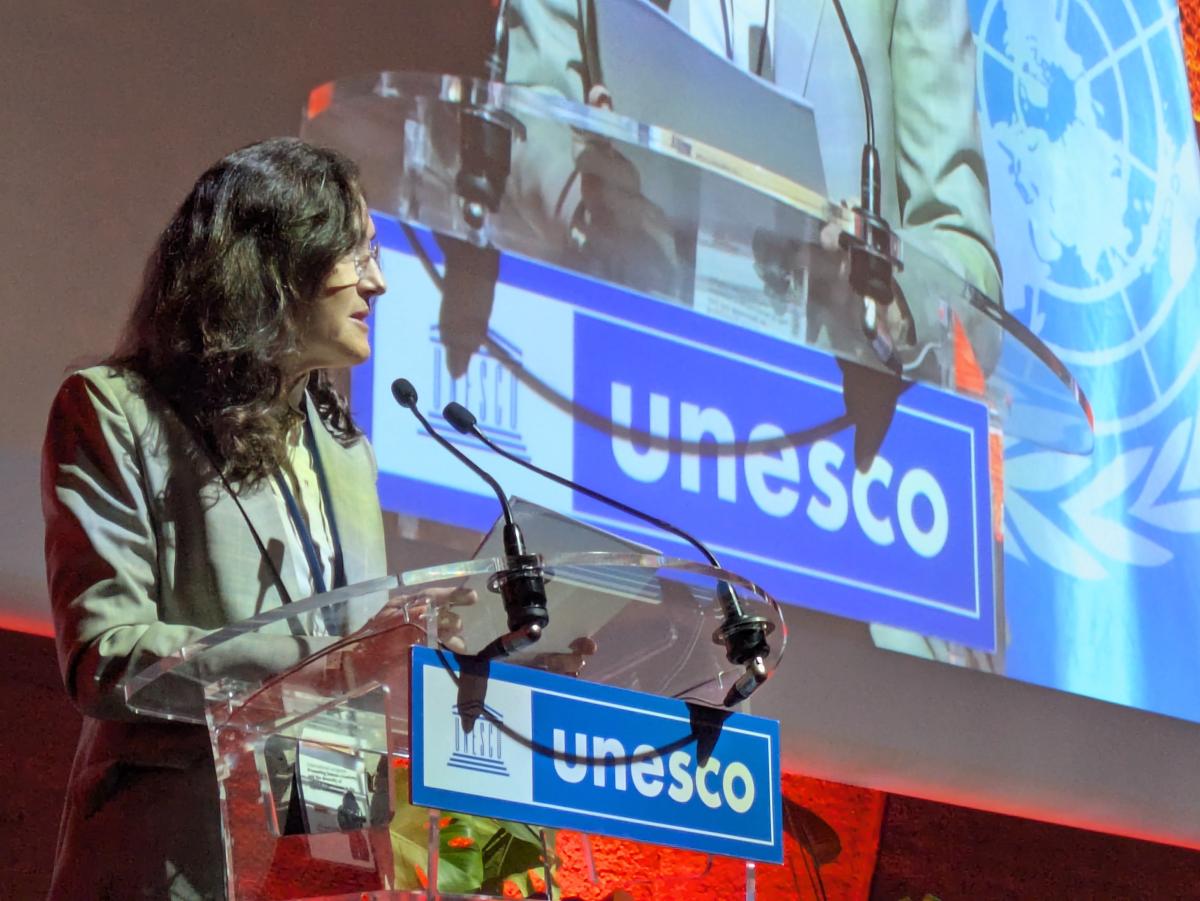
On 27 October 2026, CISAC Vice-President Ángeles González-Sinde delivered a keynote address at the UNESCO Congress Promoting Human Creativity and the Diversity of Cultural Expressions in the Digital Environment, held in Paris.
Read the full transcript of her speech below.
________
Good morning and thank you for inviting me.
I am a screenwriter and a film director, and a Vice-President of CISAC, which represents more than five million creators around the world.
I want to begin with a sentence that everyone in my profession knows by heart. The screenwriter William Goldman wrote: “Nobody knows anything.”
Not one person in the film business knows for certain what will work. Every film is a conjecture. If you're lucky, a well-argued one.
That is what creating is: sailing without a map. It is frightening, and it is expensive. So, for a century, the industry dreamed of a map. Now it thinks it has found one.
Production notes have changed their language. They used to say a script worked or did not work. Now they say things like: “The data shows that this type of character does not connect with the target audience.”
And generative AI arrives promising the perfect map: a formula for success.
I now have conversations with producers who calculate how much they can save by replacing part of a writers' room. That calculation did not exist three years ago. AI still does not write well, in the deep sense of the word. It does not need to. It only has to be cheap enough to make us accept less.
However, I did not come here to defend screenwriters. I came to defend the conjecture, because everything that matters in culture begins as one.
The Convention that brings us together says it in a single sentence. Cultural activities, goods and services convey “identities, values and meanings, and must therefore not be treated as solely having commercial value.”
In other words: culture is an exception.
Algorithms do not work with exceptions. They work with the greatest common denominator. They find what most people already like, and they hand it back to us. A culture run on that principle does not die. It just becomes average.
Three years ago, I took part in a UNESCO debate on AI and audiovisual. I went in afraid of the homogenisation of storytelling. My notes said it was already happening. I wish I could tell you that I was wrong.
Let me give you an example that is not a film.
Flamenco.
Rosalía has taken her own version of flamenco heritage to audiences around the world. Her success is real, and it is hers. But picture a system that learns what flamenco is from her numbers. It will conclude that flamenco sounds like Rosalía.
Because for Rosalía to exist, many others were necessary: cantaores and cantaoras whose records sold only a few hundred copies, if they were ever recorded, and whose names most people will never know. No chart recorded them. The market counted her sales, and it did not count them.
The psychologist Mihaly Csikszentmihalyi, who spent his life studying creativity, wrote: “Creativity does not happen inside people's heads, but in the interaction between a person's thoughts and a sociocultural context.”
Rosalía is the person. The cantaores are the context. Take away the context, and there is nothing left to interact with.
And it is not only about who is small today. It is also about who came before.
Today is 27 October. It's UNESCO's World Day for Audiovisual Heritage. My father was a filmmaker, like me. He died in 1992, before the digital age. His films are online. What is not online is everything around them: the interviews, the articles, the conversations, the studies.
Even the photograph that Google shows for him is not him. It's somebody else.
Is he less relevant than I am in the history of Spanish cinema? To a newcomer, yes. To those who knew his work, no.
A large language model learns what matters from what has been written about it. It confuses being talked about with mattering. And whatever the digital age did not talk about drops out of the story, not because anyone judged it, but because no one counted it.
Csikszentmihalyi left us a warning that I would hang on the door of every ministry and every platform: “We believe that things that can be measured are real, and we ignore those that we don't know how to measure.”
So let me say it in my own words. If we measure only what can be counted, we will lose what we never learned to count.
The Convention calls cultural diversity “a defining characteristic of humanity”. I want to give you two reasons why it matters now.
The first is creative. Csikszentmihalyi observed that creativity tends to flourish where cultures meet, where beliefs, lifestyles and knowledge mingle. A culture that mixes less has less to recombine.
The second has nothing to do with heritage. Diversity trains us in friction.
Much of digital technology is an effort to remove friction. We can block and mute those we disagree with. Algorithms recommend what we already like. And chatbots, as the MIT professor Sherry Turkle says, always agree with us and affirm us. She warns that we are “de-skilling ourselves as relational beings”, and that “friction is not a bad thing.”
I would add: cultural diversity is where we practise it. Expressions that are not our own, and that matter to others, teach us to talk across differences, and democracy depends on that habit. In stories we say: no friction, no fiction. It is true of societies too.
But to be exposed to diversity, we have to be able to find it. How does a documentary in an indigenous language travel beyond its own valley? How does a first-time director compete with content that can be produced in seconds? Systems that recommend and generate culture learn from what is already visible. The small and the unusual are the least likely to be learned at all.
A Spanish screenwriter, Diego San José, said something that no policy paper has said better: “If AI takes away what is joyful, solving narrative problems, finding the solutions, why would I write scripts? I would rather do something else.”
I know what he means. When I use these tools to create, something is missing. I have not gone through the process: the struggle, the thinking, the slow arrival at an idea or a new way of seeing. The result is there, but I am not.
It leaves a void in me.
So here is the question I would like to leave to the room: what happens to a species that gives up the experience of discovering? What are stories, songs, drawings for us, to us as a species?
Iris Murdoch said that we are fantasising, imaginative animals. We survive by telling ourselves stories. What matters, she argued, is what drives them. When they are driven by fantasy, we get small myths, toys and crystals that shield us from the truth. When they are driven by imagination, we get art that shows us the beautiful, messy reality of being human.
Fantasy consoles; imagination demands. It makes us look, pay attention to what is there, including the people who are not us.
Now think about a machine trained to be acceptable to as many people as possible. It gives us the story, the song, the drawing we already wanted. It is very good at small myths. Murdoch had a word for fantasy: mechanical. The difference I am asking you to protect is not between humans and machines. People make plenty of fantasy too. It is between a culture that consoles us and a culture that tells us the truth. And only one of the two can be produced by an entity who never had to face reality.
The Cuban artist Félix González-Torres said that, above all, art is about leaving a mark that I existed: “I was here. I was hungry. I was defeated. I was happy. I was sad. I was in love. I was afraid. I was hopeful. I had an idea, and I had a good purpose, and that is why I made works of art.”
A machine can produce an image. It cannot say: I was here. It was not.
I want to be honest about something. I want these tools. My dream is to write with images and not only with words on paper. I would like to have a sketch of a film before I am on the set shooting this film. Many creators I know feel the same. We are not afraid of technology.
So, the question is not whether we use AI. It is on what terms. We have to live with AI, not under it.
Let me say what that means, because words like consent, transparency and remuneration have become so familiar that we have stopped hearing them.
Consent is not a question of how much. It is a question of yes or no. Consent is the right to say no. If we cannot say no, we do not consent. An opt-out that nobody can exercise in practice is not consent.
Transparency begins with a simple fact: we cannot negotiate what we cannot see. And there is a quieter point. A right to say no, without any way to identify our works inside the training data, is a rule on paper and a fiction on the ground. No country can build that infrastructure alone. No guild, no society, however well organised. It must be built together.
Remuneration. The companies call it learning. We call it ingestion. In November 2025, a court in Munich, in a case brought by GEMA against OpenAI, found that training a model is not a neutral act of reading: works are memorised. We do not want to switch these tools off.
We want to license them.
And the numbers are not abstract. A study commissioned by CISAC in 2024 estimates that, if the regulatory framework does not change, 24% of music creators' revenues and 21% of audiovisual creators' revenues will be at risk by 2028.
In the last month alone, two books have asked the questions this speech is asking.
Sherry Turkle's asks what talking to machines does to us. Xavier Nueno, a Spanish author, asks why we have accepted that universal knowledge is being privatised. UNESCO's own AI ethics work says that AI business models are “highly concentrated” in a few countries and “a handful of firms”.
Nueno argues that those firms have taken the intellectual and creative legacy that libraries kept for centuries and are selling it back to us by subscription. Knowledge that belongs to everyone is kept alive by those who add to it. A company that takes it and sells it back to us adds nothing. It just takes.
Turkle also points us to Joseph Weizenbaum, who built one of the first chatbots back in the sixties. It was called ELIZA. His warning was not only that we might think computers can be like people. No, it was that we might come to think people can be like machines and so give up our agency. That is the danger I would ask you to keep in mind.
Regulation is not censorship. It is democratic hygiene. The argument that regulating AI kills innovation is not an argument. It is a strategy of delay.
A few years ago, right here at UNESCO headquarters, Yvonne Muinde, a visual effects artist from Nairobi, made a request I have not forgotten: that everyone be seated at the table where the rules for AI are written, those on the low end too.
So, I invite you to work together.
First, to widen the table. Bring creators, those on the low end too, into every forum where the rules for AI are written. Not after the decisions. During.
Second, build what is missing. Use UNESCO's convening power to bring together creators' societies, parliaments and international bodies to build a shared way to identify works. A platform launched at WIPO in March 2026 has begun the task. It needs allies. And let transparency, consent and fair remuneration be the reference points in UNESCO's work on the digital environment, so that governments do not each start from zero.
Third, ask the diversity question of every system. Make it part of how AI is assessed: what does this system do to the small, to the minority, to the exception?
Earlier this year, creators from around the world gathered in Paris for CISAC's centenary and adopted the Paris Commitment. Its starting point is simple: creativity is what makes us human.
It calls for technological progress that strengthens creative value instead of weakening it. And it asks that human creators, local stories, languages, voices and traditions remain at the centre of our cultural future.
Last February, in Berlin, I ended with Fritz Lang's Metropolis, which turns one hundred next year. It ends with a handshake between the master of the city and the leader of the workers. I asked whether that was a utopia. I said: “Who knows? Time will tell.”
Today I can say something different. Nobody knows anything. Nobody knows whether those hands will join. But that is exactly why it is ours to decide. A conjecture is not a prophecy. We can make it come true.
Let us make sure there is a table with enough chairs, and that someone human is still allowed to take the risk of being wrong, or of being unplugged.
Thank you.